Obținerea straturilor poroase de oxid de galiu prin tratamentul termic al straturilor poroase de GaP obținute în urma anodizării
Apr 1, 2022·
Cătălin Creciunel
Principal Investigator
·
1 min read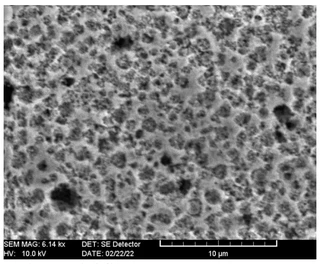
Abstract
This study explores the fabrication of porous gallium oxide ($Ga_2O_3$) with controlled morphology through the thermal treatment of porous GaP layers obtained via anodization. The research focuses on optimizing thermal parameters to ensure complete oxidation while minimizing structural defects such as cracks. Systematic analysis of morphology and chemical composition before and after treatment demonstrates the feasibility of obtaining high-quality porous oxide layers on a semiconducting GaP substrate with good electrical conductivity.
Type
Publication
Conferinţa tehnico-ştiinţifică a studenţilor, masteranzilor şi doctoranzilor
Research Methodology
The transition from Gallium Phosphide (GaP) to Gallium Oxide ($\text{Ga}_2\text{O}_3$) is a delicate process that requires precise control over the thermal environment to preserve the porous architecture.
Optimization Process:
- Controlled Morphology: The initial porous structure of GaP, created via anodization, serves as a template for the resulting oxide.
- Crack Mitigation: By fine-tuning the heating rates and peak temperatures, the internal stress within the oxide layer was minimized, preventing the formation of macro-scale cracks.
- Chemical Consistency: EDS (Energy Dispersive Spectroscopy) was likely used to confirm the transition from phosphide to oxide throughout the layer’s depth.
Key Results:
- Substrate Integration: Successfully maintained a high-quality interface between the porous oxide and the bulk GaP substrate.
- Electrical Conductivity: The resulting layers retained favorable electrical properties, essential for sensor and optoelectronic applications.
- Porous Network: The high surface-to-volume ratio of the porous $\text{Ga}_2\text{O}_3$ makes it an ideal candidate for gas sensing and photocatalysis.
Scientific Context
This work established the baseline for future experiments in wide-bandgap oxide synthesis at UTM, demonstrating the potential of thermal treatment as a reliable tool for material phase transformation.

Authors
Cătălin Creciunel
(he/him)
Research Scientist & Embedded Systems Engineer
Cătălin Creciunel is a graduate of the Technical University of Moldova,
specializing in microelectronics and nanotechnology. With over 5 years of
experience as a Research Scientist, he has developed innovative solutions
for semiconductor materials including ZnO, GaP, and InP through thermal
treatment and anodization techniques. His expertise spans embedded software
development in Python and C/C++, hardware design using CAD tools, and
nanotechnology research including semiconductor and composite nanofiber
production. Cătălin is dedicated to advancing technology through continuous
learning and innovative contributions to microelectronics and embedded
systems.