Design and Implementation of a Low-Cost Electrospinning Setup for Nanofibers Fabrication
Oct 17, 2024· ,,·
1 min read
,,·
1 min read
Cătălin Creciunel
Lead Developer & Award Recipient
,Vladimir Ciobanu
Vitalie Postolache
Eduard Monaico
Abstract
This paper presents an advanced electrospinning device designed for novel nanomaterials production, focusing on its innovative software architecture and open-source approach. Built around an Arduino Mega, the system utilizes FreeRTOS for real-time task management. The development workflow incorporates PlatformIO and GitHub Actions for CI/CD, ensuring cross-device compatibility. Key hardware features include a high-voltage source with precise feedback and LCD-based parameter tuning, providing a scalable and accessible platform for nanotechnology research.
Type
Publication
International Conference on Electronics, Communications and Computing (ECCO)
Note
🏆 Recognition: This work was recognized as an award-winning abstract at the ECCO 2024 conference for its innovative approach to open-source laboratory instrumentation.
System Architecture
The project stands out by applying modern software engineering principles to hardware development:
- Real-Time Control: Implementation of FreeRTOS on the Arduino Mega ensures that motor timing and high-voltage safety checks are never interrupted by UI updates.
- DevOps for Hardware: Use of PlatformIO and GitHub Actions allows for automated firmware building and testing, facilitating collaborative research.
- Modular Design: The system is designed to be easily adapted for different syringe types and high-voltage requirements.
Conference Highlights
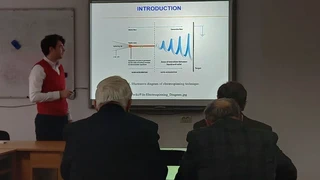
ECCO 2024 Presentation


Legacy: ECCO 2021


Impact and Applications
By providing a low-cost yet precise alternative to industrial electrospinning units, this setup enables laboratories to:
- Accelerate Prototyping: Rapidly test new polymer solutions for nanofibers.
- Collaborate: Share and improve the control code via the open GitHub repository.
- Education: Serve as a transparent platform for teaching embedded systems and materials science.
This research was supported by the institutional subprogram #02.04.02 and the youth project #24.80012.5007.12TC.

Authors
Cătălin Creciunel
(he/him)
Research Scientist & Embedded Systems Engineer
Cătălin Creciunel is a graduate of the Technical University of Moldova,
specializing in microelectronics and nanotechnology. With over 5 years of
experience as a Research Scientist, he has developed innovative solutions
for semiconductor materials including ZnO, GaP, and InP through thermal
treatment and anodization techniques. His expertise spans embedded software
development in Python and C/C++, hardware design using CAD tools, and
nanotechnology research including semiconductor and composite nanofiber
production. Cătălin is dedicated to advancing technology through continuous
learning and innovative contributions to microelectronics and embedded
systems.