Advanced Functional Materials & Aeromaterial Templates
projects

As a research engineer at the National Center for Materials Study and Testing (NCMST), I contributed to the synthesis, processing, and high-resolution characterization of advanced nanostructures. This work was a core component of the Young Researchers Project #24.80012.5007.12TC, funded by the National Agency for Research and Development (ANACED), spanning 1.5 years from 2024 through 2025.


The Challenge: Synthesizing Next-Generation Ultra-Lightweight Aeromaterials

The primary objective of this project was the synthesis and structural engineering of novel, ultra-lightweight, high-porosity 3D networks (aeromaterials). The core challenges addressed by our research group included:

  • Phase Stabilization: Controlling precise phase transitions between magnetite ($\text{Fe}_3\text{O}_4$) and hematite ($\text{Fe}_2\text{O}_3$) during high-temperature thermal treatments.
  • Structural Integrity: Maintaining the ultra-low density macro-porous architecture of Gallium Nitride (GaN) nanonetworks when using sacrificial templates.
  • Process Automation: Replacing inconsistent manual laboratory protocols with automated embedded setups to guarantee repeatable environmental conditions during electrochemical and redox cycles.

Research & Engineering Solution

To overcome these barriers, our team developed a hybrid approach combining chemical nanotechnology, custom automated laboratory setups, and high-resolution electron microscopy.

1. Advanced Material Processing

My responsibilities centered on designing and operating automated custom hardware systems to optimize the chemical pathways:

  • Thermal Oxidation & Reduction: Utilizing automated PID-controlled thermal setups to handle precise ramp-up profiles, crucial for controlling the phase evolution of the iron oxide networks.
  • Electrochemical Modification: Performing precise oxide formation on diverse sacrificial metallic substrates to establish uniform pore sizes.
  • GaN Aeromaterial Templates: Investigating the uniform growth of semiconductor thin layers on lightweight porous templates intended for advanced optoelectronic and sensor applications.

2. Characterization & Morphological Validation

To evaluate the quality and crystalline layout of the resulting architectures, I performed extensive analysis utilizing advanced laboratory infrastructure:

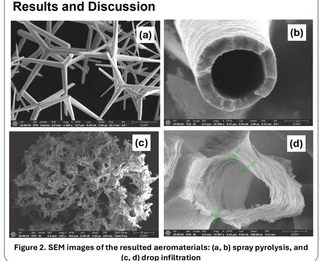
  • Scanning Electron Microscopy (SEM): Investigating surface topography, pore distribution, wall thickness, and microstructural damage.
  • Redox Stability Studies: Observing how the microstructural skeleton of $\text{Fe}_3\text{O}_4$ networks reacts to continuous thermal and chemical stress.

Academic Dissemination

The scientific outcomes generated during this 1.5-year research initiative were compiled and presented to the international scientific community across multiple prestigious events:

  • BPU12 Congress (Bucharest): Presented oral/poster sessions detailing the precise fabrication protocols and structural parameters of novel iron oxide-based aeromaterials (Exploring Quantum Frontiers).
  • MacroYouth 2025 (Iași): Showcased advanced optical and structural characterization data of synthesized $\text{Fe}_3\text{O}_4$ structures, engaging with regional experts in additive and chemical material synthesis.


The experimental data, morphological studies, and synthesis methodologies validated during this ANACED-funded project are directly documented in the following internal publications:

1. BPU12 Congress Proceedings

Full paper and presentation abstract regarding the synthesis and quantum frontiers of novel iron oxide nanonetworks. Read Publication

2. MacroYouth 2025 Scientific Session

Poster session and experimental methodology covering the comprehensive optical and structural characterization of $\text{Fe}_3\text{O}_4$ aeromaterials. Read Publication

Cătălin Creciunel
Authors
Research Scientist & Embedded Systems Engineer
Cătălin Creciunel is a graduate of the Technical University of Moldova, specializing in microelectronics and nanotechnology. With over 5 years of experience as a Research Scientist, he has developed innovative solutions for semiconductor materials including ZnO, GaP, and InP through thermal treatment and anodization techniques. His expertise spans embedded software development in Python and C/C++, hardware design using CAD tools, and nanotechnology research including semiconductor and composite nanofiber production. Cătălin is dedicated to advancing technology through continuous learning and innovative contributions to microelectronics and embedded systems.