AI-Based Radiation Sensor Developed for UTM Satellite Mission

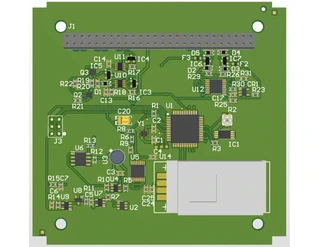 Satellite Module Prototype for BIRDS-RPM
On June 16, 2025, the Technical University of Moldova (UTM) was featured in the media for preparing the launch of two nanosatellites. One of the key contributions involves the development of an AI-based radiation sensing module — a project I am actively involved in — under the BIRDS-RPM international satellite mission.
“I am designing one of the modules of this satellite. My module aims to measure the level of cosmic radiation — a critical parameter for astronauts. It consists of two radiation sensors (analog and digital), followed by the circuit design stage.”
— Cătălin Crăciunel, interview for TVR Moldova
Project Purpose
The goal is to demonstrate the use of:
- Two radiation sensors: Integration of both analog and digital sensing paths.
- FPGA logic: A dedicated circuit for real-time SEU (Single Event Upset) detection.
- Edge AI: A neural network deployed on-chip for radiation classification and filtering.
- Nanosensors: Validation of cutting-edge materials in space conditions.
Project Context
This mission is part of J-CUBE, coordinated by LaSEINE (Japan) and hosted at Kyutech, with the following objectives:
- Obj-001: Demonstrate AI-based radiation sensor using COTS components on FPGA.
- Obj-002: Select nanosensors for detection of nanoscale chemical/physical properties.
- Obj-003: Integrate and test the nanosensor modules under space radiation.
- Obj-004: Assemble and integrate the complete payload stack on BIRDS platform.
- Obj-005: Receive, analyze and adjust data from ground stations for further evolution.
- Obj-006: Educate students in space-grade systems and advanced technologies.
🔬 Technical Implementation (2026 Paper)
The reference radiation module utilizes a dual-channel detection strategy, as detailed in my recent publication:
- Dose Rate Estimation: The AL54 Alpha Sensor handles digital pulse counting (proportional to mSv/h).
- Cumulative Dose: The VT01 RADFET measures total ionizing dose from 1 cGy up to 1 kGy.
- Data Handling: An ATmega1284 microcontroller processes the signals and communicates via I²C with the main onboard computer.
[!NOTE] The paper describing the design and functionality of this module is available here.
Media Mentions
Impact and Innovation
This project explores:
- On-device AI inference: Using FPGA for low-latency radiation detection and classification.
- Extreme conditions: Testing nanosensors for orbital radiation and high-vacuum stability.
- Scalability: Future applications in ISS, nanosatellites, and environmental sensing.
The innovation lies in bringing intelligence to the edge: one level of AI is directly embedded in the FPGA radiation sensor, and another in the MCU interfacing with the system.
Technical Update: June 16, 2025
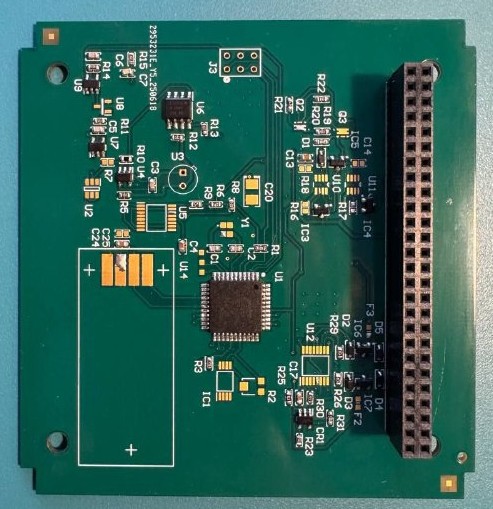
Front Side
Module front-side PCB layout
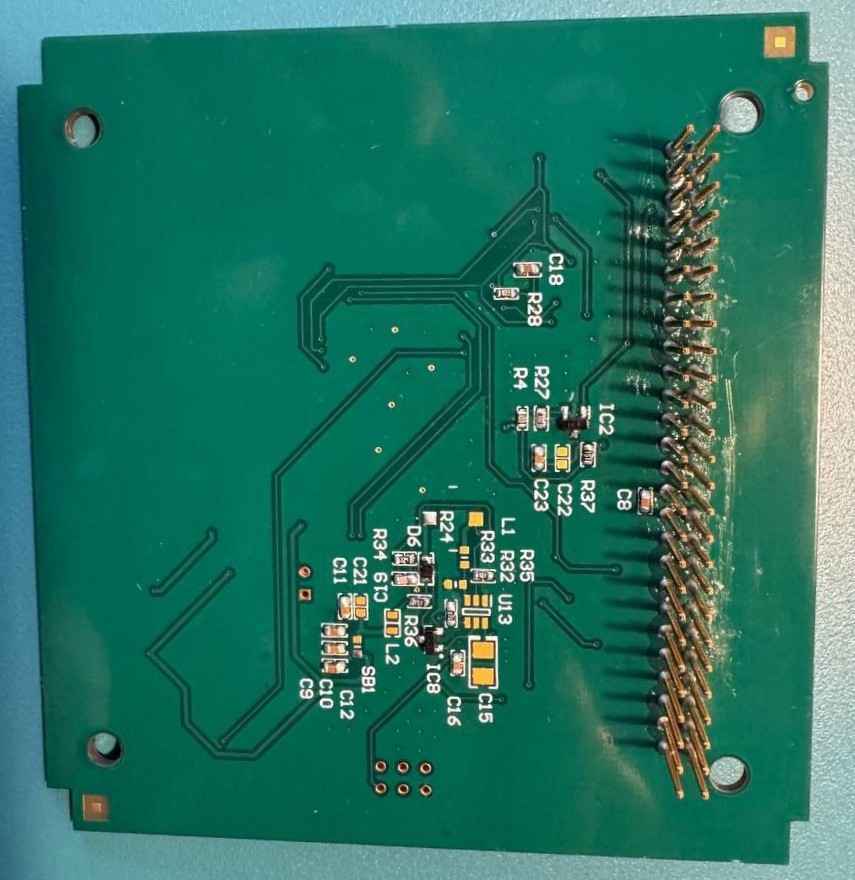
Back Side
Module back-side PCB layout
📌 This project is realized in collaboration with UTM and LaSEINE Japan, under the BIRDS-RPM satellite program.
